

Academic integrity in the AI Era: reflections and responsibilities

Professor Li emphasises that even in the AI era, it is humans, not machines, who remain central to the production, preservation and dissemination of knowledge.
In his article for the Financial Times (“A tide of fake research risks scientific integrity”, 6 November, 2025), Professor Bernhard Sabel, a professor of medical psychology at the Otto von Guericke University of Magdeburg, estimated that between 5% and 15% of all papers published annually in the biomedicine field are fake. This alarming figure highlights a growing crisis in academic publishing, where the integrity of scientific discoveries is increasingly under threat.
One of the driving forces behind this phenomenon is the immense pressure to publish. Under the “publish or perish” ethos, academics are compelled to produce articles and books to maintain or advance their careers. The pressure is very real, for many higher institutions require their faculty to publish a set number of works within a certain timeframe to secure tenure. Stress and anxiety rise significantly when academics juggle teaching, research and administrative duties, and whether they meet publication targets or not, it becomes a bread-and-butter concern.
Some higher institutions incentivise publication not only through recognition and promotion but also through financial rewards. Such pressure and temptation can, at times, lead members of academia to resort to dishonest practices in order to achieve their goals. After all, in the battle for reputation and success, academics are fallible like all human beings. According to Professor Sabel, the Middle East, East Asia, Russia and the global south make up a large proportion of fake papers.
The recent emergence of generative AI has made it far easier to produce fake essays and research papers.
While dishonest publication has long been a concern, the recent emergence of generative AI has made it far easier to produce fake essays and research papers. Although the benefits brought by generative AI across industries are undeniable, its unchecked use has revealed significant drawbacks. In academia, unregulated use of AI results in substandard publications plagued by misinformation, questionable data and fabricated references—often a consequence of artificial hallucination.
The issue, however, extends beyond individual misuse of AI. In a talk given at Stockholm University last year, Professor Sabel has highlighted the corrosive impact of AI-assisted, industry-scale operations known as essay mills. These mills offer everything from data generation and ghost-writing to bribing journals for guaranteed publication. This parallel industry, driven by academics and students eager to publish, directly facilitates academic fraudulence. With the rise of generative AI, the productivity of these mills has increased dramatically.

Professor Li notes that if fabricated publications and misinformation continue to grow, perceived progress in science, technology, medicine and the social sciences will increasingly stand on unstable ground.
Academics are entrusted with the sacred duty of producing, recording and disseminating knowledge. The public places immense trust in us, believing that the insights we provide will bring about technological innovation, improved medical treatments, stronger social policies and better decision-making. When fabricated publications and false knowledge accumulate, apparent advancements in health, technology and society will increasingly rest on unstable foundations.
At FLASS, we recognise the importance of this duty, and we remain committed to sharing knowledge that contributes to the betterment of society. This issue of FLASS FORWARD is honoured to feature the distinguished lectures delivered by two renowned scholars and this year’s EdUHK honorary doctorate recipients: Professor Justin Yifu Lin and Professor Michael E. Mann. Professor Lin, a highly regarded figure in international economics on Chinese issues, spoke about “The Great Change in the World and China’s Rejuvenation”. Professor Mann, a prominent climate scientist and advocate, delivered a lecture on “Urgency and Agency in Addressing the Climate Crisis”. Their insights are well worth reading.
This issue also introduces the work of Professor Bill Yeung Chi-ho in the Department of Science and Environmental Studies (SES). As an enthusiastic physicist, he shares his current research, what motivates him to pursue fundamental work in statistical physics and the satisfaction the subject brings. Dr Chan Man-ho, Associate Dean (Undergraduate Studies and Student Learning) of FLASS, explains how he explores the mysteries of the universe through astrophysics and philosophy while maintaining his religious faith.
Turning knowledge into practical solutions to real-world problems is one of the cornerstones of FLASS. Warm congratulations go to our scholars whose inventions won accolades at major international invention festivals earlier this year, including the Silicon Valley International Invention Festival (SVIIF) in California, the 10th International Invention Innovation Competition in Canada (iCAN 2025) and BRICS Inventions 2025. I would also like to express my appreciation to the faculty members who were named among the World’s Top 2% Scientists by Stanford University.
Cultivating the next generation of capable scholars is another important mission of FLASS. This newsletter features interviews with PhD candidates Ms Skylar Sun Yuanke from SES, Ms Vivien Tang Foong Yee and Mr Sai Htong Kham from the Department of Social Sciences and Policy Studies (SSPS), among others, to learn about their doctoral journeys. They share the challenges they encountered during their studies and how they overcame them.
Hong Kong’s rope skipping athletes have been excelling on the international stage. Beyond the athletes themselves, coaches, sponsors and organisers have all contributed to the sport’s development in Hong Kong. Professor Amy Ha Sau-ching, the new Head of the Department of Health and Physical Education (HPE) who founded the Hong Kong Rope Skipping Association, China (HKRSA) in 1997, is one of the key figures behind this success. In this issue, Professor Ha and HPE student and rope skipping athlete Sophie Poon Yin-ting discuss the development of rope skipping and the pride they feel in the city’s achievements.

Professor Li states that although institutional factors such as intense academic competition and an overemphasis on publication metrics contribute to dishonesty, it is equally important for individuals to uphold their own integrity.
As we celebrate the successes of our faculty, we must also remind ourselves that achievements must be accompanied by honour. As the bastion of knowledge, academia cannot compromise when dishonesty, negligence and forgery arise. Institutional factors such as academic competitiveness and the dominance of publication counts in performance assessments certainly play a role in the rise of fake knowledge, but personal integrity remains equally important.
Without integrity, the academic world is at risk of collapse.
Education has two broad aims: the production and preservation of knowledge, and the cultivation of character. A key component of this cultivation is academic integrity, which involves careful verification of references, proper citation and the responsibility to contribute one’s own ideas rather than simply repeating others’ work. Although it is a complex topic requiring deeper discussion, one point remains clear: without integrity, the academic world is at risk of collapse.
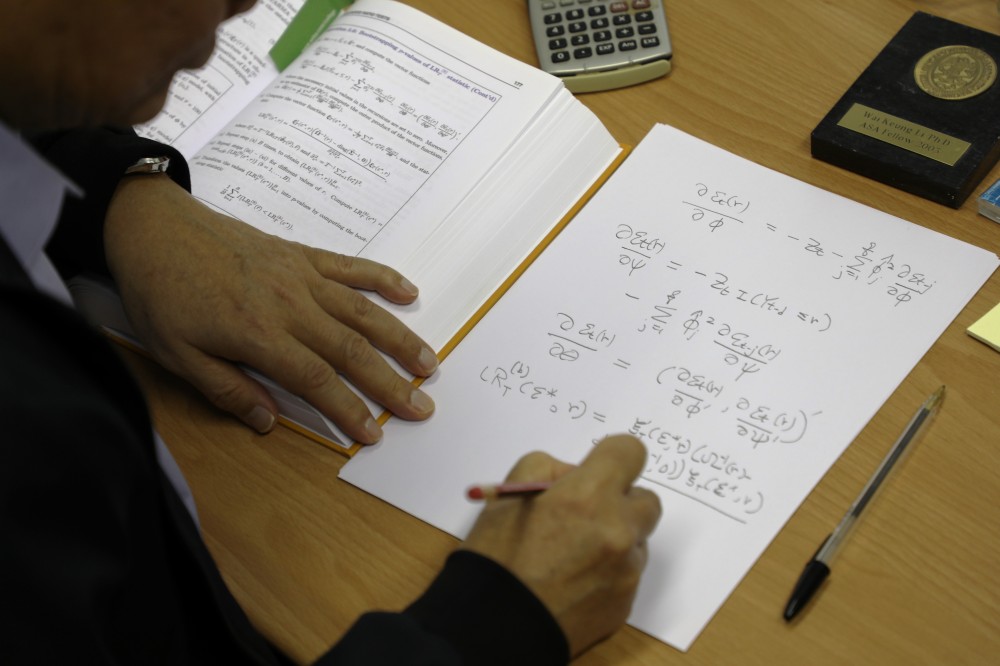
Human civilisation is sustained through the accumulation of knowledge and the cultivation of humanity, goals pursued by intellectuals across ages. While collective efforts are needed to combat organised paper fabrication, individuals within academic institutions must also recognise that although new discoveries and publications may secure a position, integrity determines the true value of our contribution to human civilisation. Unfortunately, the temptation to compromise integrity may become even harder to resist amid intense academic competition and the growing capabilities of generative AI. Preserving academic integrity will be an uphill battle, but it is one we must continue to fight.
Professor Li Wai-keung
Dean of FLASS
28 November 2025
Professor Li Wai-keung collaborated with Tam Siu-man on this message.
References:
1. “A tide of fake research risks scientific integrity”, Financial Times, 6 November, 2025
2. Professor Sabel’s talk “Fake-publications in science: a rising concern of knowledge pollution” at Stockholm University, 9 October, 2024.
